The writer will be writing about popular events in her area. Keep posted!
Tuesday, April 15, 2014
Thursday, January 9, 2014
The Dressmaker of Khair Khana by Gayle Tzemach Lemmon
After reviewing "The Dressmaker of Khair Khana" book once again in preparation for book club. I decided to post some highlights of the book as it is terribly exciting book, if you ever thought to be a journalist. The author of the book begins her introduction by going over her background and her are some of her accomplishments.
When winter break approaches at Harvard business school, (Writer of "The Dressmaker of Khair Khana, Gayle Tzemach Lemmon attends at age 30 for a masters degree), Lemmon decides to make a trip to Kabul, as she finds it intriguing that Kabul is becoming a hot spot where when have created business opportunities for themselves, at a time when their is a takeover in the country and they are barred within their homes. (this point is up for discussion).
Previously Lemmon, had worked for ABC news covering political campaigns, and began her research in Rwanda, where women were beginning to create businesses there as well.
When winter break approaches at Harvard business school, (Writer of "The Dressmaker of Khair Khana, Gayle Tzemach Lemmon attends at age 30 for a masters degree), Lemmon decides to make a trip to Kabul, as she finds it intriguing that Kabul is becoming a hot spot where when have created business opportunities for themselves, at a time when their is a takeover in the country and they are barred within their homes. (this point is up for discussion).
Previously Lemmon, had worked for ABC news covering political campaigns, and began her research in Rwanda, where women were beginning to create businesses there as well.


Tuesday, June 25, 2013

I read Stephen King's " 11/26/63". A great novel for the beginning of the summer. It was filled with fantastic characters, and of course a story line based on the true story of the assassination of JFK.
King knew how to bring much attention to the character of Lee Harvey Oswald, (according to the government investigations, he was the sniper who killed JFK) King introducing him in the middle of the novel and Oswald is portrayed as a working class man, nothing particularly interesting or great about him, although he was was a US marine and was defected to the Soviet Union in October 1959, where he lived until 1962, and returned to the US with his Russian wife.
I liked how the main character Jacob, (code name George) is able to build a short term career as a teacher , all the while going back to the past as prime investigator, in search of the truth of JFK's assassination. His modern research and clues into the case, give him an edge to preventing the assassination. It also allows him, to delve into Oswald's inter sanctum, as readers are introduced to some of the key players of Oswald's life including: Margaret Oswald, (his wife), Marguerite Frances Claverie (his mother) and friend George de Mohrenschildt, amongst many other associations.
Thursday, April 18, 2013
"Where the Red Fern Grows" by Wilson Rawls

"Where the Red Fern Grows" by Wilson Rawls. The most memorable part of this book is when Billy Colman, the main character wears his father's raccoon hat and goes hunting with his hound dogs: Old Dan and Little Ann. He gets into fights with the Pritchard brothers, and he dreams of getting his dogs to hunt in the coon hunting contest, which will have him training his dogs around the clock, hunting raccoons and rodents alike. The book's climax is when Billy Colman sets out to get the "ghost coon". This final hunt will intrigue readers and have them wandering if Billy's dog will reach the same demise as "Old Yeller" (a story which most kids, born after 1990 have no recollection)
Many dog enthusiasts will conjure up sympathetic emotions in the final act of "Where the Red Fern Grows".
My second read-through of this book came when I was an assistant teacher in a middle school class, in the inner city, and this was there book of the month to read. I enjoyed the book discussions with these middle school kids in particular , because they commented on the book so freely (that is if you,the teacher, asked the right questions.) For example a popular discussion question was:What is your favorite part of the book? A middle-schooler response was "I like the dog fights", this was usually punctuated with a middle school teacher asking him or her, if they ever been to a farm or been hunting? If they ever seen a dog's role on the farm? Most likely a kid in the inner city, would respond "no" they never been to a farm, and plain in simple, they thought a dog's role, is "to be a dog". The Global Dig
"Beautician of Kabul" by Deborah Rodriguiz

Monday, April 15, 2013
"The Murder of a Century:The Gilded Age Crime That Scandalized a City & Sparked the Tabloid Wars" by Paul Collins

"The Clan of the Cave Bear" by Jean M. Auel

"Into Thin Air" by Jon Krakauer

Saturday, April 13, 2013
"Let the Great World Spin" by Colum McCann
"Let the Great World Spin " by Colum McCann, a combined-story novel. I enjoyed this novel, and the way McCann spins the stories of characters who have unlikely chances of meeting one another. One of the stories discusses two Irish brothers, Corrigan and Ciaran who are on two different wave lengths, but end up both leaving Ireland and eventually living together in the Bronx.
We are introduced to Corrigan, who as a child empathizes with the poor, and who will do absolutely anything he can for the poor. He tells his mother that their situation is not that bad in comparison to those who have absolutely nothing. He meets the poor under bridges as they warm their hands, Corrigan listens to their stories. When the father of the brothers walks out of their lives, Corrigan brings the poor people his father's clothing, and his brother Ciaran merely watches as he gazes onto random strangers walking on the beach with his father's suits on.
McCann also tells the story of Philippe Petit, the French acrobat who is a tight-rope walker.
Its my belief that McCann introduces such a factual story into the plot of the book so as to raise the drama of novel and cast a story that readers can automatically visualize:The Twin Towers.
 Petit decides to walk the lengths of the former TWIN TOWERS just to see if he can do it; adding to his collection of buildings he's walked across. His walking between the TOWERS brings the attention of the New Yorkers who look up at him, in astonishment and see only a tiny speck in the sky, wandering who could possibly have the gall to do such a thing, admiring him, and at the same time holding great fear for this man's life.(the Global Dig)
We are introduced to Corrigan, who as a child empathizes with the poor, and who will do absolutely anything he can for the poor. He tells his mother that their situation is not that bad in comparison to those who have absolutely nothing. He meets the poor under bridges as they warm their hands, Corrigan listens to their stories. When the father of the brothers walks out of their lives, Corrigan brings the poor people his father's clothing, and his brother Ciaran merely watches as he gazes onto random strangers walking on the beach with his father's suits on.
McCann also tells the story of Philippe Petit, the French acrobat who is a tight-rope walker.
Its my belief that McCann introduces such a factual story into the plot of the book so as to raise the drama of novel and cast a story that readers can automatically visualize:The Twin Towers.
 Petit decides to walk the lengths of the former TWIN TOWERS just to see if he can do it; adding to his collection of buildings he's walked across. His walking between the TOWERS brings the attention of the New Yorkers who look up at him, in astonishment and see only a tiny speck in the sky, wandering who could possibly have the gall to do such a thing, admiring him, and at the same time holding great fear for this man's life.(the Global Dig)
Thursday, April 11, 2013
"The Second Empress: A Novel of Napoleon's Court " by Michelle Moran

"The Second
Empress: A Novel of Napoleon's Court," by Michelle Moran.
This novel reads with a feminist point of view, of the French Revolution. Although the second empress is characterized as being weak and without much power over her destiny and over her new Kingdom in France, Michelle Moran does an excellent job in her research of Napoleon.
Napoleon takes a second empress, Marie Louise. Louise will have a task keeping France together as she is left in charge while Napolean begins one of France's worst Revolutions.The empress convinces French citizens to take refuge at the Chateau de Rambouillet. Once its obvious that Russia is winning, Napoleon makes a retreat to France
while his Army is still fighting Russia
Marie Louise is worried about her solitary son whom she has, had with Napoleon. Napoleon wrote a letter to Joseph, a former king of Spain telling him his hopes for his son: "Id rather see my son's throat cut
than imagine him brought up as an Austrian prince in Vienna
The fact that Napoleon would rather cut his son's throat,
than have him live in Austria
tells the empress that she'd better make like a bandit and get her and her son out of Napoleon's line of vision. She decides to take her son, against the father's will to live in Austria

"The Good Earth" by Pearl S. Buck

Well, start by buying out- all the nearby farmer's land; making yourself the envy of all the farmers in your village. Then have tons of kids, so they can help you harvest your land. This will ensure that you're no longer a peasant, but in fact, a successful farmer who has plenty of power. You'll have so much power, that you'll be able to buy your own wife from her servant hood. So she can in turn come back to the home of her servant days and show off her own child, richest baby in the kingdom, festooned with silk clothing and shiny fat from eating the stuff of the "Good Earth". (the Global Dig)
"Rosa Lee:A Mother and Her Family in Urban America" by Leon Dash

Lee's resolve in understanding that what she is doing is downright wrong came when Leon Dash, the writer asked her if she thought it was right to ask her granddaughter to steal clothing from a thrift store. This had a powerful effect on Lee, for which she realizes that she is teaching her own grandkid to steal.
Thursday, April 4, 2013
"A Year in Provence" by Peter Mayle
"A Year in Provence" by Peter Mayle
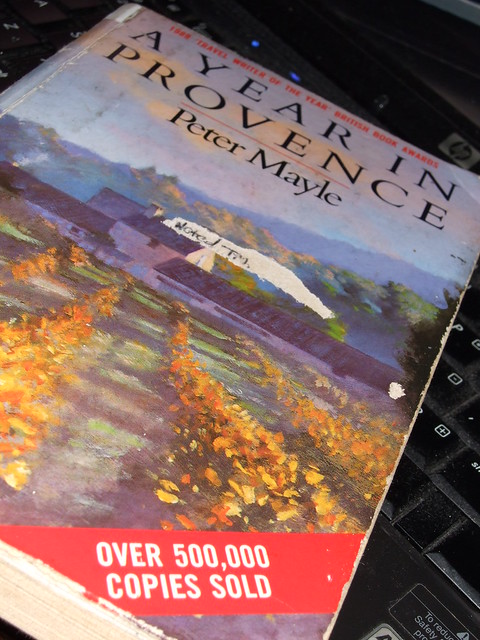
Mayle's writes a memoir, that in my belief, reads very smartly. Mayle is a British writer and he commemorates upon his move to Provence and the struggles he undergoes; learning the language and day to day cultural norms that seem very bizarre to his own.
Mayle's first introduction to the world of Provence comes with his decision to buy and reconstruct his first home in Provence. He hires French masons whom he believes will transform his ancient home into a functioning Parisian home that will suit his many Parisian guests. The Masons break out with sledge hammer on their very first day working on his kitchen effortlessly for hours at a time before the sun even rises. They up level floors and reconstruct new ones. This sprint like effort of the French will amaze Mayle until he realizes that after a couple of days of hard work his masons are no where to be found. Mayle's first lesson: The French have an elasticity when it comes to how they view time.
I like the way Mayle describes his introduction to his new neighbors in France. He says that they speak with an incomprehensible French drawl, adding the "ong" sound to words in French that normally don't necessitate this suffix. He says they spoke words in a fast, chattery way for which he could barely grasp.
This British writer talks about the bitter cold during his stay in France during the winter season.
And like most weather enthusiasts, I merely gaff at this notion of exaggerated cold weather in France; thinking to myself "these French people don't know anything about the cold," with my new profound pride in Minnesotan weather.
I also think "The French know nothing of snow blizzards and negative-twenty-degree-Fahrenheit wintry days like we have in Minnesota."
This writer, likewise, has his own objections to the "Wimpy French"; comparing the cold days in France to his days in Britain for which he battled the wind that came up from the British channel.
One of the most strategic moves the writer made, was a trick to get Parisian contractors to finish his house, by hosting a Holiday dinner (knowing full well that food would draw the contractors to his house).
For his dinner, Mayle decides to invite the wives of his contractors so that they could admire the work of their husbands. This plot had the desired affect. The contractors readily showed up the following day to finish the house they started.
Lesson number two:If you want Parisians to get things done: Always bribe them with food.
Wednesday, April 3, 2013
"The End of Your Life Book Club" by Will Schwalbe
 "The End of Your Life Book Club" by Will Schwalbe. I started reading this novel after it caught my attention in the library's three day, book rental shelf. Like most book lovers, I am part of a book club( I admit this) and my book club has been meeting once a month for the last ten years, albeit, I have only been a member for, four years. Either way, this novel was a definite hit home for me!
Author, Will Schwalbe has been working in publishing for 21 years, and it was Schwalbe's admittance to his 73-year-old mother that he had not read a book on her list which would begin this two member book club
"Crossing to Safety" was the book on his mother's list. For which she exclaimed "I'll give you my copy" Schwalbe was getting David Halbersam's book on the Korean war ready for publication but he found time to meet his mother while she was in the hospital dying from cancer. There we have it "The End of Your Life Book Club."
Mary Anne's, Schwalbe's mother had done many accomplishing things in her seventy three years old life span, for which Schwalbe talks about admirably. His mom helped to establish libraries in Afghanistan. She went there in 1995, going across the Khyber pass from Pakistan to report on the condition of refugees. She went back to Afghanistan 9 times for the women's commission on the international rescue committee (the mothers keeps in contact with all the refugees she has met in Afghanistan).
"My mother was always introducing, scheduling, weighing in, guiding advising and counseling" says Schwalbe. He connects this with the fact that, his mother had taken a job at Harvard and Radcliffe University and was appointed associate dean of admission and Financial aide.
One funny story Schwalbe shares about his mother's career at Harvard is when she received a fortune cookie from an eager student awaiting admission in to the college and the fortune cookie read "You will admit Bella Wong"-the daughter of the local Chinese restaurant owner.
Mary Anne would later work at Cambridge University for which Schwalbe comments that during Thanksgiving "we invited anyone we knew who lived afar away and couldn't get home, we often had Iranian and Pakistani students come...perhaps this is where my mothers interest in the region began".
Saturday, March 30, 2013
"The Art Forger" by B.A. Shapiro

This is how the character, Clair, a painter initially blocks the guilt from her conscious, when she takes up an art seller on his his offer to duplicate Degas' work and showcase it as an original. She tells herself "There's no crime in copying a painting."
Readers are introduced to Clair, an amateur artist, as she is sorting through her paintings deciding which decides ones she should display on Common Wealth Avenue. Her paintings include "Woman Leaving Her Bath" and "The Tower" Reproductions.com pays her to repaint them and sells the paintings online as "perfect replicas" unfortunately this only pays a few thousand dollars per painting. Not nearing enough to pay for rent, painting supplies and her tab at a local bar.
Not only is Clair barely surviving on an artist' wage but she also fails to win at the Art World Trans contest to another painter. Clair will do anything to seek revenge on this painter, and when Markel, a rich art seller, tells her that he'll get her work showcased at a One-Woman Show at Markel 6, Clair is entranced by this offer, knowing this is exactly the revenge she seeks. She becomes even more allured when Markel offers $50,000 to Clair, to paint for him one of Degas' original work. Markel plans to sell it as an original, which is illegal, but he counteracts this term of illegal, by saying "there is illegal, and then there is illegal."
"The Kite Runner" by Kaled Hosseini

Friday, March 29, 2013
"The Girl with No Shadow:A Novel" By Joanne Harris


Subscribe to:
Posts (Atom)