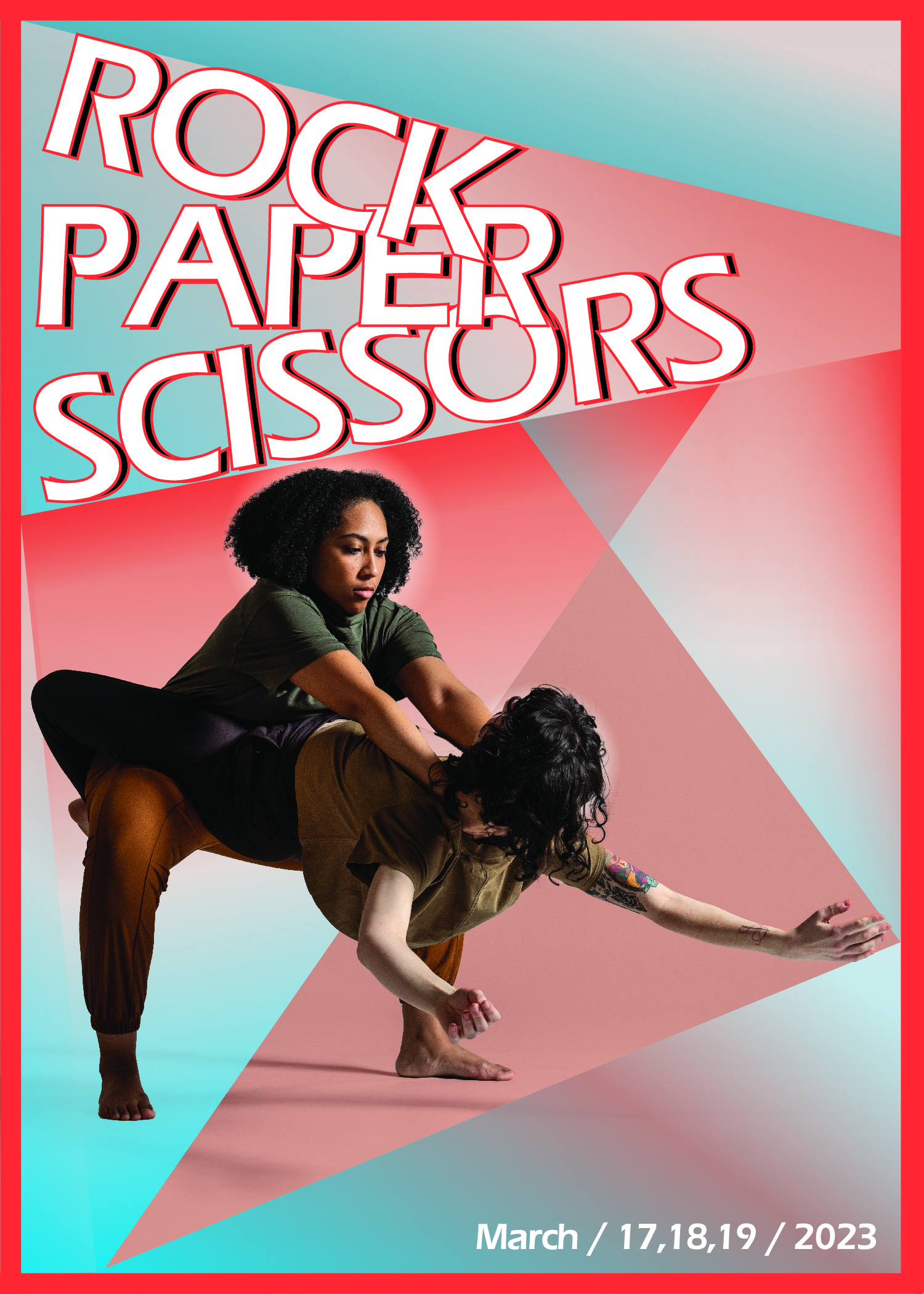
Interview with choreographer, Alexandra Bodnarchuk who presents Rock, Paper, Scissors at The Southern Theater March 17 - 19.
RPS explores traditions, are there any that come to mind?
An early and informative discussion the cast and I had was about what rules we learned growing up. Examples include: don’t eat before dinner, don’t poop in public bathrooms, be kind, etc. We talked a lot about how we are taught rules in a binary of ‘yes’ and ‘no’, and that as we mature we learn that there’s a lot more gray area between ‘yes’ and ‘no’.
Much of this work is focused on researching these gray areas, the places where boundaries and our interest in exploring them come to a head.
Dancers Nieya Amezquita and Sarah McCullough are performing in this duet piece, what are some aesthetics they will be exploring? (sound, props, etc?)
This piece is multi disciplinary. The work is site specific, meaning that the dancers dance on the set, and not the full stage. The set is a floor with two opposing walls; it’s 24 ft long, 10 ft wide, and 7 ft high. There’s a soft side which is covered by 4 mattresses, and a hard side which is uncovered. This allows the dancers to make sound in different ways throughout the course of the piece, which they do with great gusto.
Laughter and text play an important role in this work. It came into the process so naturally when Lisa ‘MonaLisa’ Berman was part of the process. Unfortunately Lisa had to step away from the project due to commitments with her company, BRKFST, but her contributions remained. I started using text in the generative process. For example, I would tell the dancers to improvise while telling each other a story. For some sections the text has gone away completely, for others it’s become full sections. I’m very grateful to our dramaturg, Marcela Michelle, for coaching the dancers on how to use their voice. As dancers this isn’t something we’re trained in, so having Marcela come in and guide that part of the process was very informative.
There’s also a lot of play in the work. From fighting over a blanket to wrestling. We actually spent a session with some friends at X2 Fitness, a Jiu Jitsu studio over on Eat Street, who taught us some Jiu Jitsu moves that have been incorporated into the work. It’s allowed us to keep it playful and improvisational, but also highly informed.
All this sits in tandem with contemporary phrase work and traditional Eastern European dance steps and traditions.
Alexandra, this dance is inspired from your heritage, can you talk more about that?
I’ve been working on this piece since August 2021 when I was a Ann & Weston Hicks Choreography Fellow at Jacob’s Pillow. What I thought the piece would be at the end of that process, vs what it’s become is not really where I thought it would end up. Something that I’ve realized is how impactful growing up learning the songs and dances of my ancestors have been. I primarily grew up within the Carpatho-Rusyn community in Pittsburgh, PA. I was a member of the North Hills Junior Tamburitzans under the direction of Zeljko Jergan for two seasons, and Slavjane Folk Ensemble under the direction of Jack Poloka for eight seasons. The Tamburitzans have a stronger Croatian focus, whereas Slavjane had a Carpatho-Rusyn focus. Because Eastern European culture is so prevalent in Pittsburgh, the way Nordic culture is in Minneapolis, there’s a lot of overlap in the Eastern European community. Because of that I learned and performed songs and dances from Slovakia, Poland, Ukraine, Macedonia, Bulgaria, Serbia, etc.
The process of making RPS reminded me of how happy I was singing and dancing those dances, and that those moments really gave me a sense of identity in such a powerful way that it just had to be in the work. It was also super fun to teach those things to Nieya, Sarah, and Kaitlyn Hawkins (our understudy). In the piece you’ll see bits of Bulgarian dances and hear the voice of Maria Mačošková, a famous Carpatho-Rusyn vocalist from Slovakia.
Alexandra, you describe how this work is about researching the ways in which you have been taught to be silent, and the ways in which you have been LEARNING to be loud, what does that mean to you?
The initial inspiration for this piece came when I attended the last pre-COVID contact jam hosted by Lindsey Forsythe in the Ivy Building. The space we were in was also a martial arts studio, and they had mattresses fastened to the wall. I was warming up by moving and pressing my body into the mattresses.
As an eating disorder survivor, my relationship with gravity is significant. The feeling of gravity pulling on my body and the tactile sensations of moving through space are a reminder that I take up space - that I have weight. Sometimes I want my fingertips to pull me into a silent flight to defy gravity and its desire to shape me. Other times I want to feel gravity thunderously pulling me to the ground. I combat the desire to be small and silent and the aspiration to be like a bird and freed of gravity.
Warming up, I enjoyed pressing and jumping into them. It reminded me of when I wanted my body to not make noise and be silent. The other side of the space the wall sounded very hollow, and any movement my body made on that wall sounded very loud.
The choice to construct the set in such a way as to amplify and deaden sound is a nod towards this journey. As a young girl and teenager I was taught to be obedient and quiet. The process of maturity for me had been intrinsically tied to building confidence in using - and knowing when to use - my voice. Perhaps that’s why text is so prevalent in the work
More about this event.
This work features dancers Nieya Amezquita and Sarah McCullough, sound design by Brandon Anderson Musser, with directoral and dramaturgical support by Marcela Michelle. Each performance will be followed by a conversation with Bodnarchuk and guest speakers: Maria Silvestri (3/17), Leila Awadallah (3/18), and Emily Gastineau (3/19). Bodnarchuk is a part of The Southern Theater’s Performance Partnership Program (PPP)